The Most Important Part of Your Marketing May Happen After the Inquiry
 A prospective student submits an inquiry. The campaign has done its job, the form is complete, and the lead enters the CRM.
But the student hasn’t moved on.
In many cases, the inquiry is actually the beginning of the most important part of the enrollment journey.
What happens next can shape how that student views the institution, how confident they feel about taking the next step, and whether they continue engaging at all. A fast, relevant response can build momentum. A generic email, delayed follow-up, or confusing handoff can stop it.
The enrollment experience is now part of your marketing.
The Inquiry Is Not the Finish Line
Higher education marketers have become increasingly sophisticated at generating interest through paid search, social media, content, events, landing pages, SEO, and other strategies.
But generating an inquiry doesn’t guarantee engagement.
Once a student raises their hand, they still have questions:
- Is this program right for me?
- What will this cost?
- Can I balance it with work or family?
- When can I start?
- What should I do next?
The quality of the experience that follows can determine whether those questions become momentum or hesitation.
A student who receives an immediate, useful response feels like the institution is paying attention. A student who waits several days for an answer may already be looking elsewhere.
Every Interaction Sends a Message
Enrollment communication isn’t just information delivery. It’s part of the institution’s brand experience.
A thoughtful response communicates responsiveness. A personalized answer communicates that the student isn’t just another record in a database. Clear next steps communicate confidence and organization.
The opposite can also be true.
Repetitive emails, irrelevant messaging, delayed responses, and requests for information the student has already provided can create frustration before a real relationship ever begins.
That’s why the line between marketing and enrollment engagement is becoming increasingly difficult to draw.
Where the Traditional Handoff Falls Short
A common enrollment workflow is straightforward:
Marketing generates the inquiry.
The CRM captures it.
The lead is assigned.
And advisor eventually reaches out.
The student responds — or doesn’t.
The problem is that students don’t necessarily operate according to that workflow. They’re researching multiple institutions, comparing programs, checking costs and schedules, and asking questions at all hours.
If they don’t get an answer when they’re ready to engage, they may simply move on.
The opportunity is to close that gap between generating interest and actually supporting it.
AI Can Extend the Enrollment Experience
The goal isn’t to bombard students with more communication. It’s to make the communication they receive more useful.
ReadyRecruit™ can provide immediate conversational engagement after an inquiry, answering common questions, gathering additional context, identifying intent, and maintaining continuity until a human advisor needs to become involved.
A student interested in program flexibility can get relevant information. Someone asking about application requirements can receive immediate guidance. A prospect showing strong intent can be identified for advisor follow-up.
The experience becomes more relevant without requiring staff to manually manage every early-stage interaction.
Marketing and Enrollment Need to Work in Harmony
This also changes how institutions should think about campaign performance.
If a campaign generates strong inquiry volume but the follow-up experience is slow or inconsistent, the problem may not be the campaign. The problem may be what happens after the click.
Marketing creates interest.
Engagement builds confidence.
Advisors provide expertise.
The student moves forward.
The strongest enrollment strategies connect all four.
The Experience Students Remember
Students may not remember which email campaign initially caught their attention or which ad they clicked.
They are more likely to remember whether the institution made the process feel easy or difficult.
Did someone answer their question?
Did they feel understood?
Did they know what to do next?
Did the institution seem responsive?
Those moments matter because enrollment decisions involve significant investments of time, money, and trust.
The institutions that recognize this can turn early engagement into a competitive advantage.
How GPRS Can Help
GPRS helps higher education institutions connect marketing strategy with the enrollment experience — from generating the initial inquiry through meaningful engagement and advisor handoff.
With solutions like ReadyRecruit, institutions can provide timely, relevant engagement at scale while giving admissions teams the insight and context they need to have better conversations.
Your marketing got the student to raise their hand. The experience that follows can determine whether they keep moving towards enrollment.

 In the competitive landscape of higher education, the distance between a student’s first inquiry and their final enrollment is rarely a straight line. Instead, it is a path often filled with “friction” — those small, cumulative moments of frustration, confusion, or delay that cause a student to stall.
 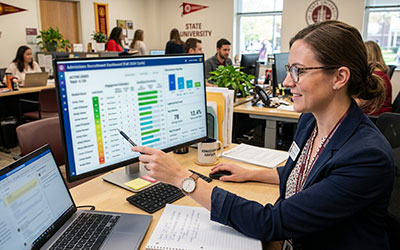 “Qualified lead” means different things at different institutions. For some, it’s anyone who fills out a form. For others, it’s a prospect who demonstrates genuine interest, meets program requirements, and is prepared to take the next step.
 Many enrollment challenges aren’t people problems — they’re system problems.
 Every enrollment leader knows this frustration: your inquiry list keeps growing, but conversions don’t rise at the same pace. One reason is simple — most systems treat every inquiry the same.
 Most admissions outreach still looks like a traditional marketing campaign: scheduled bulk messages, generic emails, and rigid, scripted follow-ups.
 Enrollment leaders often hear the same tension framed two ways: “We want to move fast” versus “We want to build relationships.” The truth? These goals aren’t competing — they’re complementary.
 Burnout in admissions isn’t a people problem — it’s a process problem.
 As enrollment teams reset for the year ahead, optimism is high — and so are expectations. But despite new goals and renewed effort, many institutions see the same inquiry behavior repeat itself: interest without momentum, volume without clarity, and pipelines that feel harder to manage each cycle. The challenge isn’t attracting students. It’s engaging them early, intelligently, and in ways that match how they explore programs now.
 Students rarely reveal their true intentions on inquiry forms. Not because they’re hiding anything — but because the format doesn’t encourage depth.