The Handoff Problem: Where Good Enrollment Leads Lose Momentum
 Marketing generates the interest. Admissions follows up. CRM systems track the activity.
On paper, the process looks connected.
In practice, there can be a gap between the moment a prospective student engages and the moment an admissions professional takes meaningful action.
That gap is the handoff – and it can be one of the most overlooked points of friction in the enrollment journey.
A prospective student might click an ad, visit a program page, request information, attend an event, or respond to a message. Marketing captures the activity and passes the lead into the admissions process.
Then what?
Sometimes the answer is immediate outreach. Sometimes the lead sits in a queue until someone has time to review it.
And sometimes the admissions advisor receives a name and contact information, but little context about what actually prompted the student’s interest.
That’s where momentum can disappear.
A Lead Is More Than a Name in the CRM
A CRM record can tell an advisor that someone engaged. But knowing that a student interacted with an institution is different from understanding why.
What program were they looking at? What questions did they have? Were they comparing options? Were they ready to take the next step?
Those details can change the next conversation.
The stronger the context that moves with a prospect, the less time an admissions counselor has to spend reconstructing the student’s journey.
The Handoff Is Part of the Student Experience
It’s easy to think of the handoff as an administrative process: Marketing → CRM → Admissions
But students don’t see it that way.
They simply experience the next interaction.
If that interaction feels generic, repetitive, or disconnected from what they were doing moments earlier, the institution can unintentionally create friction. This of course leads to the dreaded “stealth” and “ghosting” activities that institutions routinely deal with.
On the other hand, if it feels informed and relevant, the student gets a very different impression.
The handoff isn’t just an internal workflow. It’s another touchpoint in the recruitment experience.
Better Handoffs Don’t Mean More Work
The natural response to a broken handoff is often to ask admissions teams to do more: review more records, take better notes, monitor more alerts, and follow up more often.
But adding manual work isn’t necessarily the answer.
A better approach is to make the information itself more useful.
Technology can help capture and organize important signals so the admissions team has a better starting point when they engage with a student.
The goal isn’t to automate the recruiter out of the process.
It’s to give the recruiter better information when the human interaction matters most.
Where ReadyRecruit Fits
This is one area where conversational technology can play a useful supporting role.
ReadyRecruit™ can engage prospective students through email, SMS, phone or chat, answer questions, gather useful context, and help maintain engagement between interactions with the admissions team.
When a human needs to step in, that engagement can provide additional context about the student’s interests and questions.
The result is a more informed handoff rather than simply another task for the advisor.
One Connected Journey
Students don’t care which department owns a particular step. They care whether the institution understands where they are and what they need next.
Marketing and admissions may have different responsibilities, goals, and systems. From the student’s perspective, the experience should feel connected.
That means looking beyond lead generation and asking a more important question:
What happens after the lead is generated?
If the answer involves lost context, delayed action, duplicated communication, or unnecessary manual work, the handoff may be costing more than the institution realizes.
A strong enrollment strategy isn’t just about generating more interest. It’s about making sure the right information reaches the right person – and that the student experiences the transition as one continuous journey.
GPRS helps higher education institutions connect marketing, technology, and enrollment strategy to create more effective recruitment experiences.
Through solutions such as ReadyRecruit, institutions can strengthen engagement while giving admissions teams more useful context and better-supported workflows.
The goal isn’t more technology for the sake of technology. It’s a recruitment process that works better for both students and the people responsible for helping them enroll.
Ready to strengthen the connection between marketing and admissions? Contact GPRS to start the conversation.

 A prospective student submits an inquiry. The campaign has done its job, the form is complete, and the lead enters the CRM.
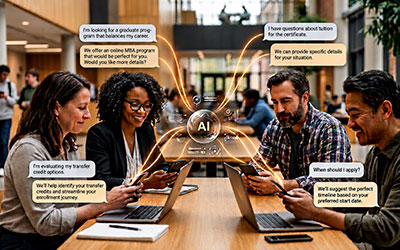 Today’s prospective students expect more than automated emails and generic marketing messages. Whether they’re exploring an undergraduate degree, graduate program, certificate, or professional credential, they want communications that feel relevant to their individual goals and circumstances.
 Engagement in the “Invisible Funnel” can make or break enrollment outcomes. Many prospective students explore programs quietly before submitting an inquiry. The institutions that capture and nurture these stealth prospects have a competitive advantage.
 In the world of higher education recruitment, “ghosting” is often misinterpreted. When a high-intent prospect suddenly stops responding to emails and texts, the natural assumption is a loss of interest. However, the reality is usually more complex. For most students, silence isn’t a rejection of the institution; it is a defensive reaction to a process that has become overwhelming.
 In the competitive landscape of higher education, the distance between a student’s first inquiry and their final enrollment is rarely a straight line. Instead, it is a path often filled with “friction” — those small, cumulative moments of frustration, confusion, or delay that cause a student to stall.
 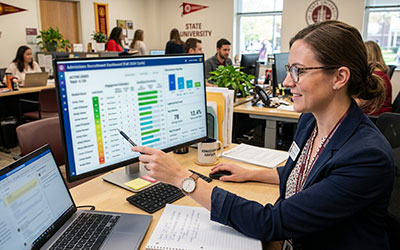 “Qualified lead” means different things at different institutions. For some, it’s anyone who fills out a form. For others, it’s a prospect who demonstrates genuine interest, meets program requirements, and is prepared to take the next step.
 Every enrollment leader knows this frustration: your inquiry list keeps growing, but conversions don’t rise at the same pace. One reason is simple — most systems treat every inquiry the same.
 Most admissions outreach still looks like a traditional marketing campaign: scheduled bulk messages, generic emails, and rigid, scripted follow-ups.
 Higher education admissions has never been more demanding. Inquiry volumes are rising, communication channels are multiplying, and prospective students expect immediate, personalized responses at every step.