Data makes decisions less difficult
 One of the biggest questions universities have about their marketing is related to its effectiveness. How do you know if your marketing spend is making a difference? And while your program may be using common tracking methods like a CRM and data points like website performance, yield metrics, and click-through rates, you may be wondering how to piece everything together to give your team an overall performance picture. We’ve compiled a roundup of past articles that showcase different ways to evaluate data, report on ROI, and make decisions using data.
Finding ways to evaluate last year’s marketing effectiveness
Marketing and recruiting success is typically evaluated in black and white terms: Did you meet your enrollment goals? What was your cost-per-seated student? How did digital advertising fare in terms of CPL? Although using a tracking method to evaluate these benchmarks at key points during the year can certainly give you a window into how well your plan worked, it’s also important to look at the results in context. And in terms of planning for the future, this may be the time to create new benchmarks that are adjustable to the market and your prospective students’ needs. Here are a few ways to find meaning in your data from the past year. Learn more in our blog, Finding ways to evaluate last year’s marketing effectiveness.
Metrics matter when you’re making decisions
During a time when resources are limited – time, money and people – it’s important to focus your efforts on clear measurable strategies and tactics that will give you a solid return on your investment. While one of the most common key metrics to gauge success starts at the top of the funnel and follows them down to seated students, there are other areas to be aware of including engagement and event attendance. In order to make decisions about your next round of spending, you’ll want to take a holistic approach to data evaluation. Learn more in our blog, Metrics matter when you’re making decisions.
Data-driven marketing: It’s not as complex as you think
Are you intimidated by the term data-driven marketing? It’s not as daunting as it sounds. If you’re not used to working with statistics, crunching numbers, or harnessing large amounts of information, there are simple ways to use data as a powerful resource to help you make informed marketing decisions. Here are some simple ways to start using the info you have to strengthen your marketing campaigns, regardless of your comfort with data visualization tools. Learn more in our blog, Data-driven marketing: It’s not as complex as you think.
Ways to track your marketing spend, optimize your campaigns and find an ROI for your graduate student recruitment campaigns
If you’re not sure if your recent spike or dip in interest, leads, or applicants is related to your advertising, the competition, the economy, or something else, you’re not alone. Gauging ups and downs in your funnel can be difficult and often cryptic. Assuming that your marketing campaign is based on a sound strategy and tied to your enrollment goals, the next most important thing you can do related to your spending is to track it carefully so you can use data to optimize your campaigns for greater success. But how do you get started? Learn more in our blog, Ways to track your marketing spend, optimize your campaigns, and find an ROI for your graduate student recruitment campaigns.
If you’re looking for an agency that is well-versed in digital campaign planning, set-up, tracking, and real-time optimizations, GPRS is your partner. Our proprietary lead optimization platform, GP Insights™, shows your real-time campaign data and can even display industry benchmark data showing how your peers and competition are trending. We can help you collect data on ROI and evaluate it so you can make sound decisions about your marketing strategy. Give us a call and we’ll be happy to give you a demo.

 In a recent
 According to a
  Although you may be staring down challenges to your planning process that include financial pressures, demographic changes and adjustments to rapidly changing technology, it’s important to realize that the opportunities that have arisen for the higher ed industry over the past year and a half have encouraged innovation and reshaping the admissions process. Whether you’re just starting to develop your projections, adjusting your enrollment goals, or creating your supporting marketing strategy, here are four ways to prepare for the next round of recruiting in the midst of another unique recruiting year.
 Perhaps one of the most important middle funnel activities your school can do is consistently communicate with your leads. One way you can ensure that your school stays top-of-mind is to remain in their inboxes. Heading into the recruiting season, one of the key things you can do to enhance your marketing is to be sure your email campaigns are cleaned up, targeted, and automated.
 Business school has always had a reputation of being sophisticated, selective – and for some, even an exclusive club. This perception can serve as a double-edged sword; it’s enticing, yet also a deterrent. For many schools, marketing includes a delicate balance of maintaining your reputation of being selective while also appearing accessible and personal. The good news is that you can address common admissions myths in your communications and your enrollment process.
 The GMAT was once seen as the gold standard in higher ed — a way to predict success of prospects in an MBA program, a determinant of quantitative skills and a judge of work ethic. And because of the test’s reputation and its status as a key gatekeeper for prospective students, many schools have been using GMAT test registrants to populate their databases for years. Due to the pandemic and recent market shifts, the GMAT is on the decline, and along with it, its ripe list of registrants. So what can schools do that have relied on this test for so long?
 If you’ve ever purchased an expensive watch, the latest handbag or designer shoes, you hope that the quality is worth the cost. Regardless of your motive for buying a luxury brand – a desire for buying the best, or the ability to show others you have refined taste, the reality remains the same – you were willing to pay a lot of money for something you hope delivers value.
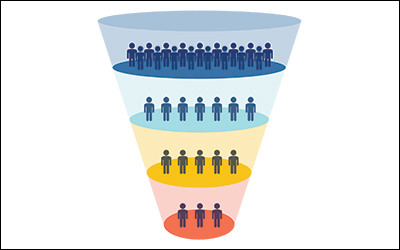 Did you ever think it would be a problem if you had too many leads? If you have generated a large number of leads but your enrollments haven’t caught up, your funnel may be top-heavy. But don’t despair — there are ways to dislodge your stalled leads, move them through the process and refill your funnel with qualified prospects for the next round. Find out what could be causing the backup and some solutions for ensuring an easier flow as you ramp up for your next recruiting cycle.
 As you plan for the upcoming recruiting year, you’ll want to make sure you have one critical element in place – an automated email communications plan.