Your prospects have stopped engaging. Now what?
 It’s crunch time. You’re finishing your final round of admissions events for the year. Your class is starting to round itself out, but you’ve still got those final seats to fill. You’re looking at each and every lead in your funnel, trying to predict which ones will take action.
If you’re like many schools, you’ve got a group of stagnant leads that you’re wondering about. Did they decide to pursue another program/school/path and forgot to let you know? Or is it possible that they may emerge from the black hole of grad school prospects and raise their hands, magically giving you that last push across the finish line of filling your class.
Stagnant leads are tricky for many reasons. Here are a few ideas on what to do with them.
Consider the decision timeline for your program
Some programs like MAcc or MSF, have an immediate decision cycle because students are coming straight out of undergrad. If you haven’t heard from them after a year, it may be time to purge them. With an MBA, the prospects could take up to 1-2 years as they are early in their careers and trying to figure out how to move up or switch directions. For an executive program such as an EMBA, it’s important to give prospects the time they need for their decision because they are weighing (already successful) careers and families to find the right time to weave school into their busy lives. Of course, you want to be sure that your messages aren’t falling on deaf ears, but giving them the time they need, even if it’s up to 5 years, may be necessary.
Audit your current communications mix
Within your current channels, is your messaging getting tired? It may be time to try something new. If an audit of your ads/emails/social/etc. reveals low response rates, get creative with your content. Are you only promoting events? Try some value added content like infographics or videos. Are you tirelessly pushing for applications, with no submissions? Try hosting an informal webinar. Other enticing information can be high profile alumni profiles or student stories. If you’ve tried these things to no avail, it may be time to develop or evolve your digital strategy.
Cater to your target and their communications preferences
You’ve heard the buzzwords surrounding multi-generational workforces. Catering your messaging to prospects with different mindsets – even if you’re inviting them to the same event – can work to your advantage. Here are a few ideas on communicating to different generations:
- Boomers – prefer face-to-face interaction but also like a balance of voicemail and email
- GenX – prefer succinct email, but since they strive for work-life balance, prefer business communications during working hours
- Millennials – prefer all forms of online communication, but need prompt feedback
Of course, these are broad generalizations. If you’re having trouble connecting with a particular age group, do some research on their communication preferences.
Vary your calls to action
Get creative. If you’re seeing some engagement, i.e. they opened the email but didn’t click, consider what you’re asking them to do. Is it too tall of an order to request that they start an application in an email if they haven’t attended an event yet? Is it possible that something is holding them back from attending an event and perhaps they’d like to connect on the phone first? Try being flexible and varying your calls to action and see what happens.
Ask them if they’d like to opt out
“No way!” may be what you’re thinking. But consider this…how many emails do you get in your inbox per day? How many online ads or social media posts do you see per day? People are overloaded. Couldn’t everyone benefit from a little less noise? A short email to prospects who’ve been stagnant may actually spur the action you want as they say, “I’ve been watching from the sidelines for too long and now it’s time for me to act!”

 An awareness campaign lives at the very top of the funnel. They are the simplest campaigns to deploy. A potential lead has never heard of your program. They may be considering going back to school to further their career but don’t know yet which college they’d like to attend. They may be researching through Google when they come across your awareness ad.
 There’s a firm in town that’s been reaching out. They’re really nice, and have a great website. Some of the other departments are using them and seem to like them. Sounds like a no-brainer for your graduate program’s needs, right?
 SEO and SEM are two very different animals, but they can be finessed into working harmoniously together. In order to create a complete and comprehensive graduate program marketing strategy, it’s best to apply them both holistically.
 In order to develop a marketing plan with impact, you must first determine who your prospective student should be. In order to do this you must ask yourself three questions: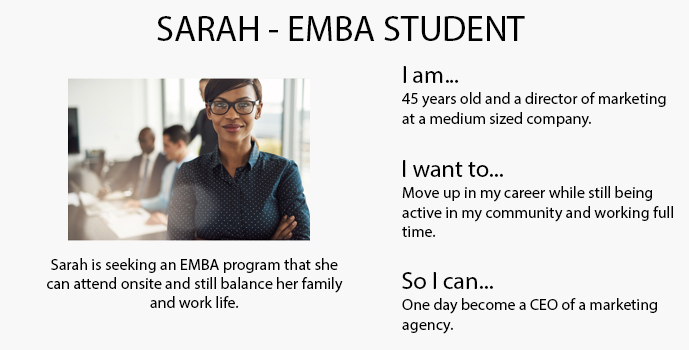
 The equation is simple:
 The decision-making process for a prospect to enroll in an Executive MBA program is painfully long. Statistics show that this process can take up to two years. So what can you do to speed up the process? Develop — and implement — a pull-through digital enrollment marketing strategy.
 Do you feel like you are constantly paying for digital marketing and garnering little results? Most programs are unsatisfied with their Return On Investment (ROI), but when they try to fix it, they don’t know where to start. What most programs don’t know is that it’s likely your marketing plan that’s to blame. But it isn’t the plan itself that’s the problem, it’s that you’re not following it consistently. The majority of marketing plans fail due to inconsistent posting, overextending platform use, and reactionary responses.